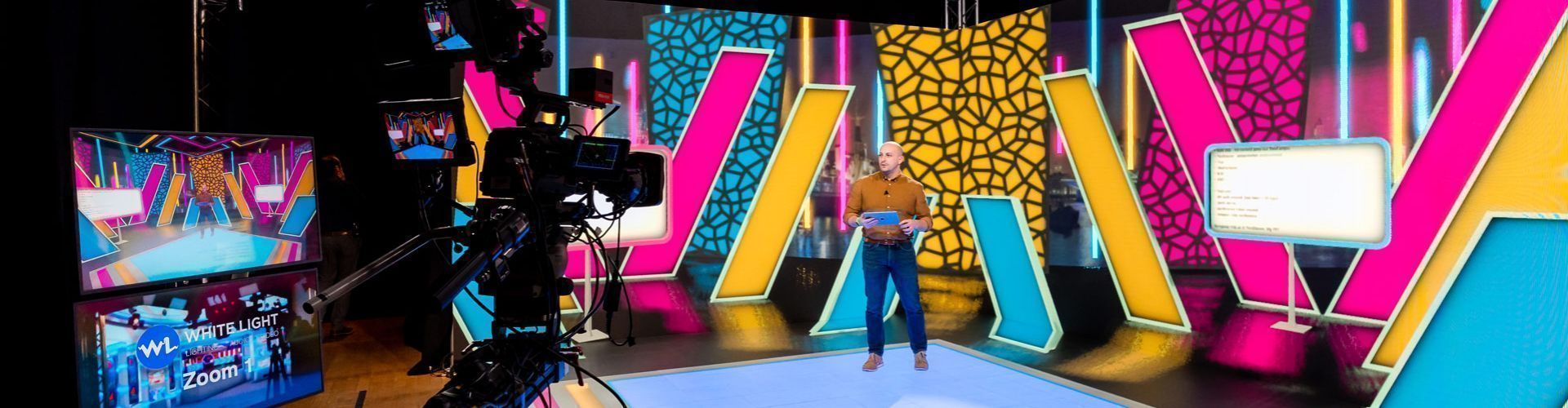
Quick Answer: LED for virtual production enables real-time in-camera VFX by syncing high-refresh-rate panels with camera tracking and game engines. (19 words)
Summary: Virtual production (VP) shifts traditional post-production tasks to an on-set, real-time workflow using high-resolution LED walls and tracking. Success in xR and ICVFX depends on selecting LED panels with the right pixel pitch, refresh rates, and color accuracy to ensure "final-pixel" results. ROE Visual collaborates with industry leaders like ARRI and Epic Games to provide the hardware foundation for these immersive environments.
What is Virtual Production?
Virtual production (VP) is a filmmaking and broadcast method that combines physical filmmaking with real-time 3D graphics. This technology has taken flight over the last year, fueled by the success of Disney’s The Mandalorian series and the impact of the COVID-19 measurements for both film productions and live events. xR (Extended Reality) is rapidly becoming the virtual production method of choice for film and broadcast.
Being involved from the start in this innovative technology, ROE Visual recognizes that it takes time, dedication, and a significant amount of technical knowledge to do this right the first time. Looking to support those interested in engaging in this business field, we dive into LED technology basics in relation to virtual production. We hope to help you find the right solution and focus on the type of technology you need for your application.
"It’s wise to discuss this with your LED provider beforehand to ensure all the individual LED panels perform and look exactly the same."

Efficient Working Methods in ICVFX
One of the primary differences between virtual production and traditional green-screen technology is that the post-production workflow has become a pre-production and even on-set workflow. This significantly diminishes time-consuming and costly post-production clean-up work. While creating a virtual studio and a virtual background is a large investment, most of the work generally done in post-production or on location can now be completed in a virtual studio, enabling a faster and more efficient workflow.
Live LED Wall In-Camera (ICVFX)
The use of image output from real-time engines to a live LED wall in combination with camera tracking to produce final-pixel imagery, completely in-camera, represents the state-of-the-art for virtual production. The benefits of live imagery projected behind the actors are massive. In some respects, it’s also the culmination of all the previous development work done in the sphere of virtual production. Unlike rear-projecting pre-rendered footage, the imagery shifts in perspective, creating perfectly synchronized parallax to the camera.

Virtual Production: Many Assets, More Technology
Virtual production is, by nature, heavily reliant on technology. This requires in-depth knowledge and experience with all the facets and elements that come into play. You need to look for a team that covers the broad spectrum of LED technology, lighting, camera, media server, motion tracking, real-time visualizer, and more.
Why Partnering is Crucial
ROE Visual partners with all the leading players in the field of virtual production. This is not by accident. Only by combining our knowledge, conducting endless testing, and syncing the equipment used can optimal results be achieved. ROE Visual is proud to partner with ARRI, disguise, Lux Machina, and Epic Games (Unreal Engine).
Determine Your Focus: xR Stage vs. Film Studio
There is a difference between xR or virtual stages for live/hybrid events and studios using virtual production that focus on shooting film and TV commercials. A typical setup for a large film studio would be an LED semi-circle of almost 360 degrees, including an LED ceiling to add ambient light and reflections. This setup allows motion tracking of the content with your camera, which produces very realistic background settings.
Considerations for LED Stage Planning:
- What types of shoots are you planning?
- What are the client’s expectations and yours?
- Who will do your content creation?
- What type of camera will you use?
Critical LED Specifications to Look For
1. Pixel Pitch
Pixel pitch is a factor to be considered when you purchase a screen. The more close-up you like to work, the smaller pixel pitches are advised. At ROE Visual, we see a high demand for pixel pitches ranging from 2.8 to 2.6 and a trend towards lower pixel pitches, like 2.3.
2. Driver IC & Scan Rate
Any LED panel’s performance is determined by the quality of the LEDs used, the type of driver IC, and the receiver card. The driver IC controls the LED to display the required brightness; more driver ICs used means a better LED performance can be achieved. Typical scan rates are 16:1, 11:1, 8:1. Refreshing smaller groups of LEDs can be done quicker and turns out to be more camera-sensor friendly, resulting in a smoother image without artifacts.
3. Refresh Rate & Frame Rate
Refresh rate is how many times per second a frame is redrawn on the display (typically 3840, 7680Hz). The higher the refresh rate, the better the screen will look on-camera. Frame rate (24, 50, 60Hz) is typically determined by the video source. Most ROE Visual LED panels can work at high frame rates, even as the industry pushes toward 120 frames per second.
4. Color Gamut
Color gamut is the color range an LED panel can display. ROE Visual LED panels cover up to 95% of the DCI-P3 color space. This is determined by the LED chip quality and the consistency of the LED batch, ensuring high coverage even after color correction.

5. Reflection and Contrast
Using additional lighting in a studio causes reflections. The blacker the LED panel is, the more contrast it provides. ROE Visual offers anti-reflective treatments and masks to ensure realistic color and better contrast even under intense studio luminaires.
6. Color Shift and Viewing Angle
It’s essential to maintain a stable color display under different viewing angles to make the virtual scene more realistic. Color shift is the shift in color when looking at the screen under an angle, which ROE Visual manages through precise diode placement.
7. LED as an Ambient Lighting Source
High-brightness LED products, such as the ROE Visual Carbon series CB5, provide natural reflections and shadows on-camera. This ambient light is critical for integrating actors into the virtual environment.

8. HDR (High Dynamic Range) Workflow
HDR output is vital for film to capture detailed shadows and highlights. Most common HDR implementations use 10-bit, while ROE Visual LED panels can support up to 12-bit image output. Black Pearl BP2 and Diamond DM2.6 support HDR playback in PQ and HLG formats.
9. Bit Depth & Genlock
Bit depth defines the number of shades for each color. Low bit depth results in color banding. ROE Visual offers up to 16-bit bit depth. The Genlock signal ensures the processors, cameras, and tracking systems are synchronized to avoid image tearing.
10. Heat Dissipation & Servicing
LED panels generate heat, which can affect color consistency. ROE Visual provides BTU information for heat calculation and utilizes common cathode technology to reduce heat. For on-site servicing, modular designs allow for quick front and rear module access.
11. Curving & Scale
The ability to create curved screens is vital for immersive environments. The ROE OneCurve™ lock allows for precise 1-degree adjustments. When scaling to installations of 1000-5000 panels, ROE Visual ensures uniformity by using identical LED batches.
A Typical xR Stage Setup Process
- Camera Tracking: Position and zoom data is sent to the media server.
- Real-time Rendering: Content is rendered and outputted to the LED screens.
- Set Extension: The disguise server fills in areas outside the physical LED walls.
- Final Composition: The result is a seamless feed of camera footage and virtual elements.
Every element—camera, tracking, servers, and LED processor—must be genlocked to prevent unpredictable delays.
For more information, visit our partners: disguise, Epic Games, and ARRI.
Frequently Asked Questions
What is the best pixel pitch for Virtual Production?
For professional virtual production, a pixel pitch between 2.3mm and 2.8mm is recommended. At ROE Visual, we see a trend towards lower pitches like 2.3mm to allow for tighter close-up shots without visual artifacts.
Why is Genlock critical for an xR stage setup?
Genlock provides a synchronization signal that aligns the LED processors, media servers, and cameras. This prevents "image tearing" and ensures the camera captures the LED wall's refresh cycle perfectly, avoiding flickering.
How does an LED wall improve the post-production workflow?
By moving post-production to the pre-production phase, lighting and reflections are captured "in-camera" (ICVFX). This eliminates the need for costly green-screen keying and reduces the time spent on digital environment blending in post.
Does the whole workflow need to be HDR-compatible?
Yes. For true HDR results, the entire signal chain—source content, processors (like Brompton or Megapixel), and the LED panels—must support HDR. ROE Visual panels like BP2 and DM2.6 support 10-bit and 12-bit HDR workflows.