
Video over IP and SMPTE 2110: Transforming Broadcast Workflows
Summary: Video over IP, specifically the SMPTE 2110 standard, is revolutionizing the broadcasting industry by enabling uncompressed video, audio, and data transport over flexible IP networks. This shift empowers various industry roles by offering unprecedented scalability, cost savings, and creative freedom. Solutions from ROE Visual, Megapixel, and disguise are leading this transition through seamless interoperability.
Quick Answer: SMPTE 2110 Video over IP enables uncompressed video transmission over IP networks, providing superior scalability and flexibility for modern broadcasters.
Video over IP (Internet Protocol) is the future of professional media transport, replacing traditional point-to-point hardware with agile network-based routing. Welcome to our discussion on the exciting world of Video over IP. In this blog, we'll delve into the concept of Video over IP and its implications across various roles in the broadcasting industry. Our disguise, Megapixel, and ROE Visual experts will share insights into how this technology transforms how we handle visual experiences.
This blog is based on our expert panel discussion at IBC 2023, featuring:
• Camilla Powell, Product Manager at disguise
• Joe Bleasdale, Product Marketing Specialist at Megapixel
• Bram Wittendorp, Technical Support Engineer at ROE Visual
Understanding Video over IP and SMPTE 2110
Video over IP refers to transmitting video content using Internet Protocol (IP) networks. While there are various protocols in this realm, such as SRT, Zixi, and NDI, we'll focus on SMPTE 2110 (simply 2110). As an industry standard, ST 2110 is unique because it treats video, audio, and ancillary data as separate elementary streams, allowing for much more granular control over broadcast assets.
SMPTE 2110 is a set of standards that allow the transport of uncompressed video, audio, and data over IP networks. Its flexibility and capabilities have gained popularity in the broadcasting industry because it removes the physical limitations of traditional SDI matrix switchers.
The Impact on Different Roles in Broadcast and Pro-AV
To truly understand the significance of Video over IP, we need to explore its impact on different personas involved in broadcasting:
- Operator: Operators desire consistency in their workflows, regardless of the infrastructure. They appreciate seamlessly switching between SDI, HDMI, and IP-based systems.
- System Technician: Technicians are concerned with scaling. Video over IP solutions offer scalability, allowing technicians to expand network capacity by adding switches rather than running miles of new copper cabling.
- Purchaser: Purchasers aim to future-proof their investments to meet long-term business goals. Video over IP systems align with their vision for future-ready hardware.
- Systems Integrator: Integrators require confidence in interoperability. A smooth transition from baseband to IP is crucial for maintaining uptime.
- Creative Director: Driven by impactful visual experiences. Higher bandwidth and support for non-standard resolutions are essential for realizing creative visions in LED volumes.
Exploring Leading Video over IP Solutions
Now, let's look closer at the Video over IP solutions offered by disguise, Megapixel, and ROE Visual.
disguise's IPvfc (Video Format Card)
- disguise's IPvfc is a groundbreaking solution for Video over IP.
- It enables a single ST 2110 video signal at up to 4K 60p video with high-quality chroma subsampling.
- It ensures consistency in operations, regardless of the output type, whether HDMI, DisplayPort, SDI, or IP-based.
Megapixel's Helios LED Processing Platform
- Helios is an advanced LED processor designed specifically for high-demand Video over IP applications.
- It converts video signals from media servers into formats compatible with LED panels.
- Helios is the first LED processor capable of native 2110 ingest and supports modular inputs.
ROE Visual's Integration with Video over IP
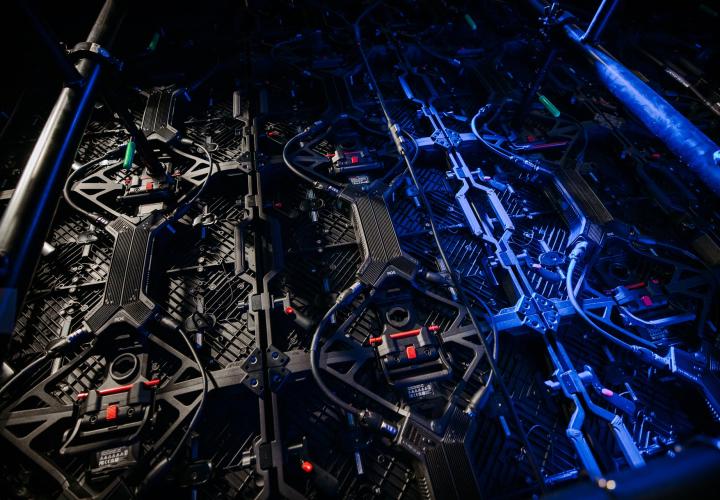
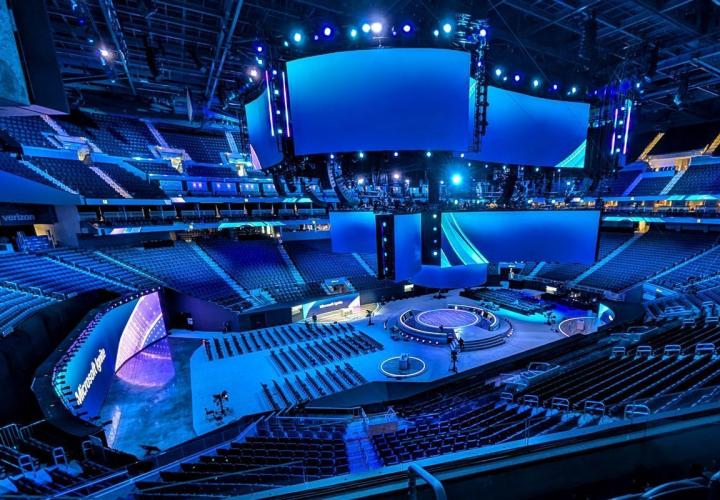
- ROE Visual's LED panels can seamlessly integrate the 2110 IP solution powered by disguise and Megapixel VR.
- The setup demonstrated at IBC 2023 included a Precision Time Protocol (PTP) generator and specialized monitoring for 2110.
- ROE Visual has an expert team to support its clients in the transfer to this technology.
Future Possibilities: The Benefits of an IP-Based Ecosystem
Video over IP has the potential to transform the way broadcast productions are managed. Key advantages include:
- Improved Flexibility: Scale infrastructure up or down as needed for different production sizes.
- Cost Savings: Reduces the need for costly, specialized cable runs by utilizing existing IP network infrastructure.
- Interoperability: SMPTE ST 2110 provides a common framework for devices from different manufacturers to work together.
- Remote Production (REMI): Enables real-time collaboration and control from off-site locations.
- Reduced Latency: Critical for live broadcasts where real-time communication between production elements is vital.
- Future-Proofing: Adapts to new formats and resolutions, ensuring broadcasters remain competitive.
Conclusion
Video over IP is a transformative technology that impacts everyone involved in broadcasting. disguise, Megapixel, and ROE Visual offer innovative solutions that enable a smooth transition to Video over IP, ensuring consistency, scalability, and future-proofing. As the broadcasting industry embraces IP-based solutions, the possibilities for creative and technical excellence are boundless.
Frequently Asked Questions
What is the main advantage of SMPTE 2110 over traditional SDI?
Unlike SDI, which bundles video, audio, and data into one signal, SMPTE 2110 separates them into different IP streams. This allows for greater flexibility, as you can route and process each element independently.
How does Video over IP facilitate remote production?
Video over IP allows high-quality signals to be transported over standard networks, enabling production crews to control cameras and servers from remote locations, which reduces travel costs and on-site staff needs.
Is Video over IP more cost-effective than baseband solutions?
Yes. While the initial setup requires network switches, it utilizes standard IT equipment and significantly reduces the amount of expensive, heavy cabling required for traditional setups.
Can ROE Visual panels support native SMPTE 2110 signals?
Yes. Through integration with advanced processing like Megapixel's Helios and disguise's IPvfc, ROE Visual LED panels function seamlessly within a native 2110 IP environment.