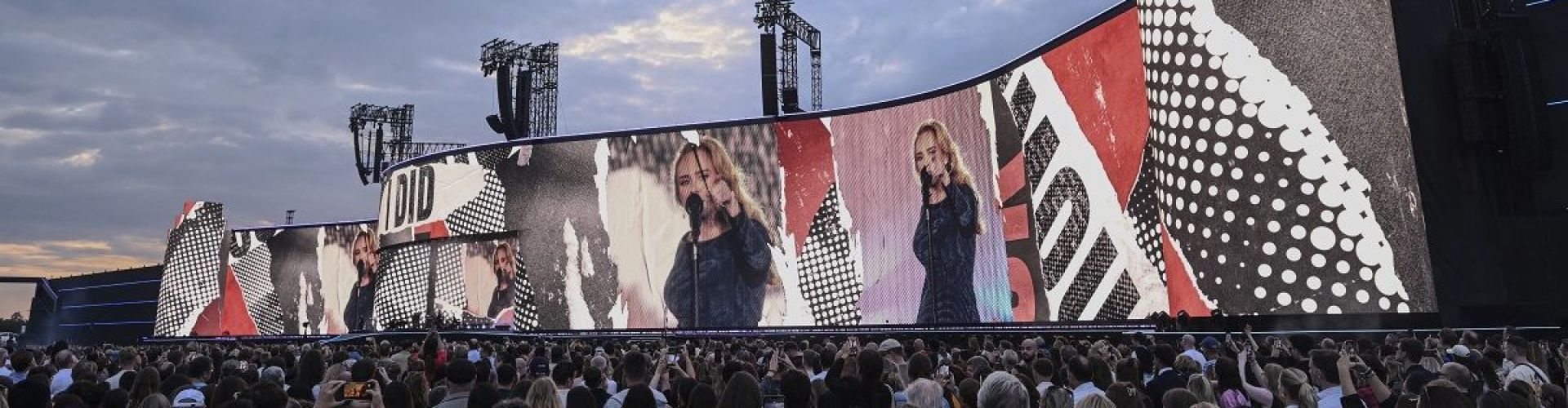
OUTDOOR USE OF LED SCREENS: Technical Guide for Temporary Installations
Summary: Temporary outdoor LED installations require specialized structural engineering to withstand non-linear wind forces and temperature-induced mechanical stresses. Proper planning involves adhering to height-specific wind pressure sectors and utilizing reinforced support systems like the ROE Visual Air Frame. Failure to account for "out-of-service" wind speeds or adequate reinforcement can lead to catastrophic structural collapse.
Quick Answer: Outdoor LED safety requires IP65+ ratings, calculating height-specific wind pressures, and structural reinforcement per TDS engineering standards like EN 13814.
Best Practices for Temporary Outdoor LED Deployments
Incidents with outdoor LED screens are a returning point of discussion. With this in mind, we would like to support all AV techs on the road with some basic information about the theory and practice concerning the use of temporary installed outdoor LED screens.
Like most products used in the entertainment industry, LED screens are utilized in outdoor as well as indoor environments. When used outdoor, environmental aspects need to be taken into account. Sun, rain and wind can have a large influence on either the performance or the structural integrity of your screen. Let us focus on a few of these influences and what you need to know about them, before you build your LED screen outdoors.
"It is almost impossible to remove a large LED screen within the accepted 15-minute timeframe for Temporary Demountable Structures"

Defining Temporary Demountable Structures (TDS)
TDS Engineering Standards and Definitions
Temporary Demountable Structures (TDS) are structures designed with the intention to be repeatedly assembled and disassembled on different locations for the duration of a maximum of 90 days.
Environmental Factors: Water, Dust, and Temperature
Water & dust: The level of protection against the ingress of dust or water is expressed in an IP number. For example IP54. IP stands for Ingress Protection, the first number indicates the level of protection against the ingress of dust, while the second number indicates the level of protection against the ingress of water. The higher the numbers, the higher the protection level. LED screens that are used in an outdoor environment should be rated IP65 or higher.
Temperature: Large fluctuations in temperature might cause excessive mechanical expansion and contraction, which will in turn cause bad fitting or seams in your LED panels. Continued high temperatures might also cause problems with heat dissipation. In general, this could occur when environmental temperatures reach above 45 degree Celsius. Below zero temperatures might cause other problems, like the expansion of freezing liquids (causing parts to crack) or condensing, which can result in damaged parts.
The Physics of Wind Force in Outdoor Environments
Wind Load Calculations for LED Screens
Wind is one of the most influential factors to take into account when using your LED screen in an outdoor environment, because it might affect the structural integrity of your screen. Many smaller and larger accidents with LED screens showcase just how devastating wind force can be.
Critical Insights into Wind Dynamics
- Non-linear force: Wind is a non-linear stream of air. This means wind is not a constant force, like air flowing from a ventilator, but wind is coming in gusts. A gust of wind holds for a couple of seconds before it decreases. These gusts of wind will cause a suspended LED screen to start swaying, thereby generating internal forces on the panel locks and LED panels. What exactly will happen is highly complex, with many factors to take into account, like surrounding structures, how the screen is rigged, the self-weight of the screen, the direction of the wind, the dimension on the screen, etc.
- Wind in relation to height: Wind force increases with height. The higher your structure is the stronger the wind force will be. Meaning the loading or pressure on your LED screen will increase with its height. Design standards for temporary structures (like EN 13814 / ISO 17842) distinguish 4 different height sectors with corresponding wind pressures, ranging from:
- 0-8 meter
- 8-20 meter
- 20-35 meter
- 35-50 meter.

 The geological location: Coastal regions are windier than inland regions. Therefore, every country is divided into wind zones, each with a different basic wind speed. The basic wind speed is a theoretical value, which any structural engineer uses to make his calculations. Germany, for example, is divided into 4 different wind zones, e.g. coastal area, inland and mountain.
- The terrain type: While on the flat and open terrain, like the beach, wind can very easily reach high speeds, in rural areas this will be much less. In general, 5 different terrain categories are defined in the standards; from coastal areas to city centers.

Aerodynamic Resistance and Structural Shape
Form Factors and Aerodynamic Multipliers for LED Display Surfaces
The shape of any structure has a direct relation to its aerodynamic resistance, e.g. how much wind it catches. For example, a Formula 1 race car has much less wind resistance than a transport truck. Design standards mention pressure factors for the wind force acting on a structure, depending on their shape. The picture below shows the wind pressure multipliers for the same LED screen but with a different “shape”. Because the space underneath the screen is closed, the aerodynamic multiplier changes significantly. The situation in the left picture will have a larger impact on the screen, while the situation in the right picture will have more effect on the structure.

Picture on the left: Form factor Cf = 1,8. Picture on the right: Form factor Cf = 1,3
Although many variables need to be considered when placing your LED screen in an outdoor environment, wind is one of the most important factors to consider.
Structural Engineering of Temporary Demountable Structures
Engineering Safety Measures for TDS Compliance
Structural engineers have different approaches to calculate TDS, depending on the application scope. Some of the possibilities are listed in ANNEX 1. The fact that TDS have short exposure times to environmental influences, lowers the probability of reaching the design windspeeds as used in building codes to calculate permanent structures. Therefore, wind pressure ratings used for TDS are lower. However, engineers should not be too positive in their approach, regular accidents show us the reasons why.
LED screens are not easy to remove in case of predicted windy circumstances. Due to this, they should be able to withstand at least the same design wind speed as their supporting structure. There is a 15-minute timeframe for equipment removal, which is generally regarded as an acceptable response time for operational measures. Any equipment that needs more than 15 minutes to be dismantled or removed needs to comply with the above.

Unfortunately, there is not just one standard to cover the whole world. Different locations are subject to different calculation rates. E.g. the European standards for TDS, exclude coastal areas. A structural report therefore never gives carte blanche, the user needs to check whether the designated building location is covered by the report, if not, additional structural calculations might be needed. The outcome of a structural report may require taking added structural measures, such as reinforcing your existing system or, worst-case scenario, selecting a different system. It is wise to do so well in time, as it simply takes time to make structural reports.
Visualizing Wind Force: The Beaufort Scale
Did you ever walk outside in the wind and rain and tried to hold on to your umbrella? Now think of the same, but with an umbrella 200 times the size. That gives you an impression of wind force. In the picture: a table showing different wind speeds versus the wind pressure and the visual effect. e.g. 0,26 kN/m2 = ~ 26kg every square meter.
| Beaufort Scale | Km/h | Mp/h | m/s | windpressure (-kN/m2) | visual effects |
|---|---|---|---|---|---|
| 4 | 20-29 | 13-18 | 5.5-7.9 | 0,04 | Dust and loose paper raised. Small branches begin to move |
| 6 | 40-50 | 25-31 | 10,8-13,8 | 0.11 | Large branches in motion. Umbrella use becomes difficult |
| 8 | 63-75 | 39-46 | 17.2-20.7 | 0,26 | Twigs broken from trees. Cars veer on road |
| 10 | 88-102 | 55-63 | 24.5-28.4 | 0,50 | Trees unrooted. Considerable structural damage |
Mechanical Stresses and Component Resistance
Bending Moments and Reinforcement in LED Panels 
Individual LED panels are interconnected to form one big screen. When wind is acting on the screen it causes all kinds of forces, like bending moments and shear forces. The LED screen and all its components need to be able to resist these forces. As LED panels are generally quite thin, you can imagine they do not have much structural strength. LED panels have an allowable bending moment ranging between 1kNm to 6kNm, while a 30cm box truss has an allowable bending moment of +/-24kNm. The point is that thin structures need reinforcement. If you imagine a building façade made of glass panels you know there’s always a steel structure in place to make it strong enough to resist the wind pressure. Just a plate of glass will not work, the same applies to your LED screen.
In the above picture: Building façade with a steel structure to withstand the wind pressure.
In the picture below: Roof structure with Keder profiles to withstand the wind pressure.

More analog to our industry is the use of outdoor roof systems. The vertical trusses or aluminum Keder profiles, which support the sidewall canopies, need to be decently sized. Canopies are also very thin, but in comparison to LED panels they are flexible, thereby generating additional lateral forces, as the material starts to bend under wind pressure. This is certainly not a thing you want your LED screen to do.
Always take the following into account when using a large screen (even if it is suspended inside a stage structure):
- Where is your screen positioned?
- Can the wind go around your screen?
- Changing wind directions
- Positive and negative wind pressure within the stage area
- What happens if the sidewalls of the stage are taken out? (In case of operational measures when reaching the “out-ofservice” state).
Suspending your LED screen in an outdoor environment will cause massive stresses in the screen, the individual panels and the suspension system. These high stresses might lead very quickly to failure of the screen or its components. You need to be able to determine the following aspects in order to calculate panel strength:
- The depth of the panel
- The quality and quantity of material used
- The strength of the panel to panel connection
- The position of the panel connection
When an LED screen starts to swing due to wind, dynamic forces will increase the internal stresses in the screen and will generate significant additional forces on the support structure and the panel connections. Attaching guy wires to your LED screen will further increase the internal forces in your LED screen, so this offers not a sufficient solution.
Additional Support and Integrated Structural Solutions
Load-Bearing Frames and Integrated Support Systems
Since it is almost impossible to remove a large LED screen within the accepted 15-minute timeframe for TDS and most standard LED screens are not strong enough to bear the forces caused by the wind, additional structural support for the LED screens is needed in most outdoor situations. These could be trusses, beams or other types of support.

In the picture: Applied support structures for LED screens during a stadium concert. The yellow dashed lines indicate the cross trusses required.
Integrating support structures for the LED screens in the overall structure is the responsibility of the staging, or construction company or the head rigger in charge. Each LED manufacturer should be able to provide you with structural reports on their LED panels, accessories and guidance for use, to enable you or your construction engineer to make the calculations needed.
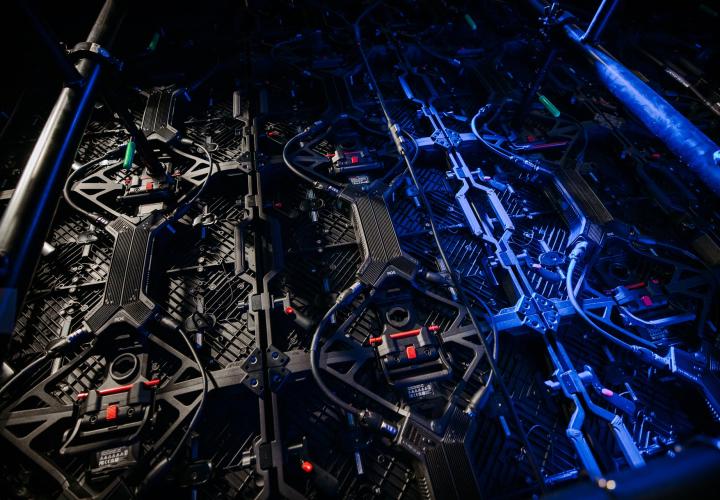
Integrated support structures: LED panels with integrated supports, like the ROE Visual Air Frame, offer an alternative to the above-mentioned supports. These types of LED panels have (often foldable) load-bearing frames integrated in the back of the LED panel, which makes them better suited to resist wind-forces. Even these panels still need extra support at the top and bottom of the screen to bear the sum of the forces.

In the picture: ROE Visual Black Quartz offers a solution for outdoor screens.
Summary and Expert Guidance
Summarizing, we can conclude that installing an LED screen in an outdoor environment needs proper knowledge of the situation and timely preparation. It is also a job that should not be left to the AV Technician alone, but that requires the knowledge of a rigger or construction engineer to make the proper calculations and resulting measures. The team at ROE Visual is always prepared to help or answer questions.
ANNEX 1: Possible Design Approaches
Comparison of Wind Speed Design Models
Approach 1- Use local building codes: By using local building codes, you can specifically detail your temporary structure for a very specific location and considering all aforementioned aspects of wind. This might lead to a lower basic wind pressure compared to the TDS standard, resulting in a lighter structure. It might be an attractive approach for a one-off-system.
Approach 2 - Use a design standard for Temporary demountable Structures with “in-service” and “out-ofservice” wind speeds: When you are touring with a structure, or building it across the country throughout the season, you do not want to make a structural report for each and every location. Using the TDS standard is therefore a much more affordable approach. The calculation values in the standard are based on a selection of the aforementioned variables related to wind from which the wind pressures for the in-service and out-of-service situation are derived. E.G the TDS standard EN13814 covers approximately 85% of a country like Germany.
As the TDS standard works with two wind pressure levels, “in-service” and “out-of-service”, the report should include operational measures to minimize the effects of wind on the structure once the out-of-service level is reached. Let us have a closer look.
- Step 1: The “in-service” wind pressure level: This level is used to calculate a structure with all loads, canopies, etc. in place. Before the wind reaches the maximum “in-service” wind speed, measures need to be taken to reduce the wind load on the structure. E.g. removing large wind catching like an LED screen, PA’s or wall canopies. Removal of these loads must be possible within a limited time frame. In general, 15 minutes is considered to be acceptable. We all know that it’s not always feasible, so you need to be realistic when choosing this approach.
- Step 2: The “out-of-service” wind pressure level: This level is used to calculate a structure assuming the structure is taken “out-of-service” and all operational measures from step 1 are taken. If the wind speed exceeds the “out-of-service” wind speeds the structure might fail. This is considered to be an acceptable risk, since no audience, performers or personnel will be on-site at the time.
Approach 3 - Use only the out-of-service wind pressure level of the TDS standard: Use the “out-of-service wind pressure” and calculate the structure with all loads in place. This is a common approach for flown or ground supported LED screens, since it is almost impossible to remove large LED screens within the limited time frame as required per approach 2. In this case, your structure needs to be stronger and requires more ballast. All elements of your structure, including LED screens and set pieces, need to be able to withstand the wind pressure.
Approach 4 - Choose a certain design wind speed: In some countries it is allowed to choose a certain design windspeed to calculate your structure. This always should be accompanied by an operational management plan and risk assessment. It might look attractive, but a good risk assessment should guarantee personal safety. The aforementioned approaches offer better and safer options in this respect.
Frequently Asked Questions
What is the recommended IP rating for an outdoor LED screen?
LED screens intended for outdoor environments should be rated at IP65 or higher to provide sufficient protection against water and dust ingress.
What is a Temporary Demountable Structure (TDS)?
A TDS is a structure designed to be repeatedly assembled and disassembled at different locations for a maximum duration of 90 days.
Why is wind force calculation different for tall structures?
Wind force is not constant; it increases significantly with height. Structural standards distinguish between four height sectors (0-8m, 8-20m, 20-35m, 35-50m) to calculate corresponding wind pressures accurately.
What is the 15-minute timeframe for equipment removal?
This is the generally accepted response time for operational measures—such as removing an LED screen—required to transition a structure to a safe "out-of-service" state when wind speeds rise.
How does the ROE Visual Air Frame help with wind resistance?
The ROE Visual Air Frame includes integrated load-bearing frames on the back of the panel, providing the structural reinforcement necessary to resist bending moments and shear forces caused by wind.
Looking for more technical information? Learn more at a the ROE Academy or read other ROE technical blogs and whitepapers.